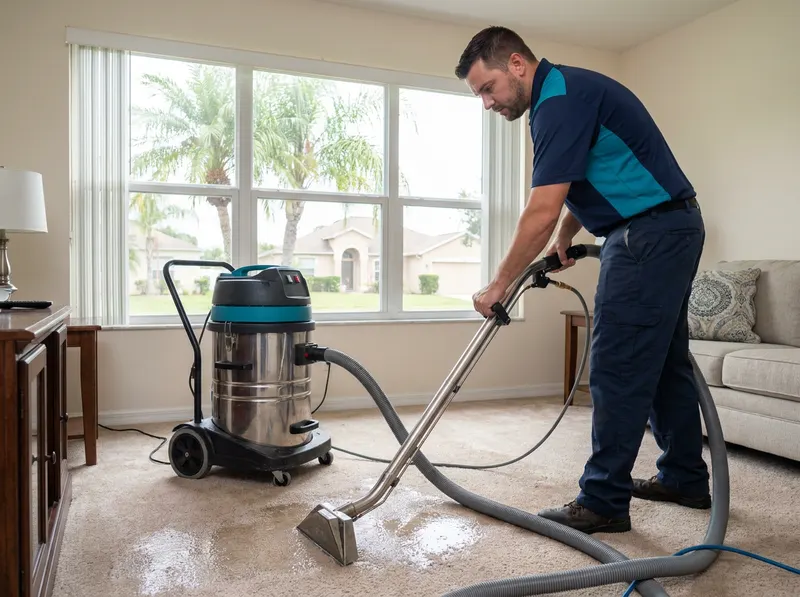
Extraction is not the same as drying. Extraction removes free-standing and surface water; the structural drying phase that follows pulls trapped moisture out of drywall, hardwood, and subfloor over the next 3-5 days with air movers and dehumidifiers. Skipping fast extraction is what turns a clean-water leak into a mold problem, Category 1 clean water can degrade to Category 2 or 3 within 24-48 hours once it sits, per IICRC S500 water-damage classifications.
Orlando's flat terrain and clay-heavy soil mean water pools rather than draining, and homes on slab foundations, common across Metro West, Hunters Creek, and Lake Nona, wick moisture sideways under tile and laminate. Summer afternoon storms and hurricane-season bands (June through November) drive most emergency calls, alongside year-round supply-line breaks and water-heater failures. A burst pipe in a two-story home near College Park behaves differently than a storm-surge flood in a ground-floor Dr. Phillips unit: the first spreads downward through ceilings, the second saturates baseboards and requires flood-cut drywall removal.
Which extraction method fits depends on the situation. If the water is clean and shallow across finished flooring, a truck-mounted extractor pulls it through carpet and grout lines fast. If a basement-style bonus room or elevator pit has feet of standing water, a submersible pump moves the bulk first, then extraction finishes the surface. If the water is Category 3, sewage backup or river/storm-surge water common after Central Florida flooding, porous materials like carpet pad and drywall below the waterline come out rather than being dried, because contaminated porous material cannot be reliably sanitized in place.
The sequence on a typical job runs: (1) shut off the water source and cut affected power circuits; (2) meter the moisture footprint to mark wet-versus-dry boundaries; (3) extract standing water; (4) remove non-salvageable pad and contaminated porous materials; (5) place drying equipment and document moisture readings for the insurance claim. Photos and moisture logs from step 5 are what most Orlando-area homeowner policies require to approve a water-mitigation claim.